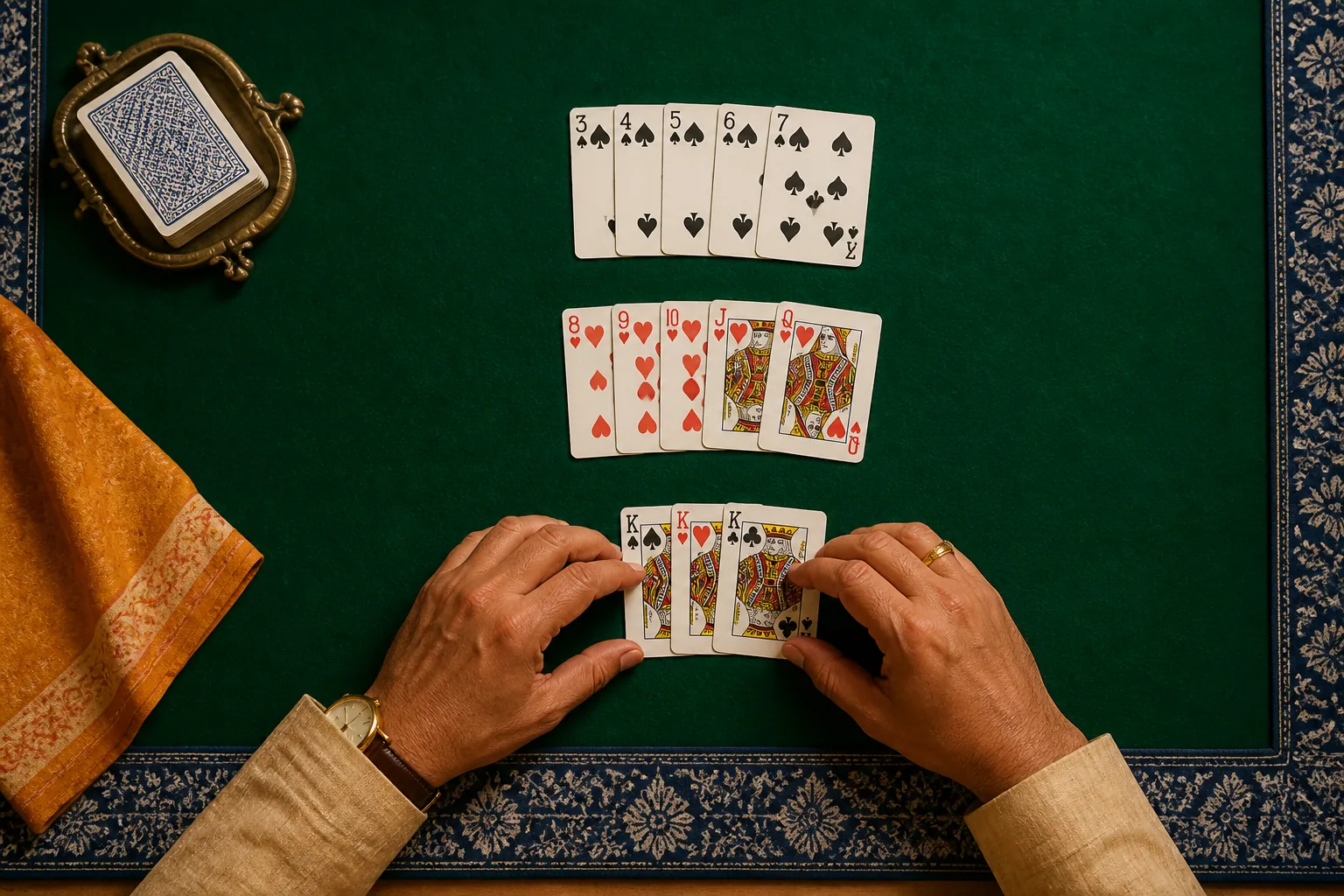
Quick answer: a pure sequence is a group of three or more consecutive cards from the same suit, formed without a joker substituting for a missing card. A standard 13-card Indian Rummy declaration needs at least one pure sequence.
What is a pure sequence?
A sequence follows numerical order and keeps every card in one suit. It becomes pure when every rank needed for that run is naturally present. For example, 4♥–5♥–6♥ is pure because the ranks are consecutive, all three cards are hearts and no substitute is used.
Pure sequence and set are not the same. A set uses the same rank across different suits, such as 8♠–8♥–8♦. A set may help complete a hand, but it cannot replace the mandatory pure sequence.
Valid pure-sequence examples
| Cards | Result | Reason |
|---|---|---|
| 3♣ 4♣ 5♣ | Valid | Three consecutive clubs |
| 7♥ 8♥ 9♥ 10♥ | Valid | Four consecutive hearts |
| A♠ 2♠ 3♠ | Usually valid | Ace is used low |
| Q♦ K♦ A♦ | Usually valid | Ace is used high |
| 9♣ 10♣ J♣ Q♣ K♣ | Valid | Five-card natural run |
Invalid examples and why they fail
| Cards | Problem |
|---|---|
| 4♥ 5♣ 6♥ | The suits do not match. |
| 4♥ 6♥ 7♥ | The 5♥ is missing, so the ranks are not consecutive. |
| K♠ A♠ 2♠ | Ace cannot normally wrap between king and two. |
| 8♦ 9♦ Joker J♦ | This can be an impure sequence, not a pure one. |
| 6♣ 6♦ 6♥ | This is a set, not a sequence. |
How does ace work?
Under common Indian Rummy rules, ace can be low in A–2–3 or high in Q–K–A. It cannot normally connect both ends of the rank order, so K–A–2 is invalid. Table rules can vary, so the rule displayed for the specific game remains authoritative.
Can a joker appear in a pure sequence?
A printed or wild joker used as a substitute makes the group impure. Some platforms allow the card selected as the wild rank to act as its natural card when it sits in its own suit and rank position. Because this detail varies, check the table rule before treating that edge case as pure.
Read the complete Rummy joker guide →
Five-point sequence checklist
- Use at least three cards.
- Keep every card in the same suit.
- Arrange ranks in uninterrupted order.
- Do not use a joker to replace a missing rank.
- Use ace only at the low or high end, never as a wraparound bridge.
Why the pure sequence matters when declaring
Finding a pure run early protects the basic structure of the hand. A hand made only from sets and joker-assisted runs is not a standard valid declaration. After securing the pure sequence, you still need at least one more sequence and valid groups for every remaining card.
See a complete 13-card declaration →
Frequently asked questions
Is a two-card run a pure sequence?
No. A standard sequence needs at least three consecutive cards of the same suit.
Can a pure sequence contain four or five cards?
Yes. Three cards is the minimum; a longer uninterrupted same-suit run can also be pure.
Do two pure sequences make a valid hand?
They satisfy the sequence requirement, but every remaining card must still belong to a valid sequence or set.
Is Q–K–A valid?
It is commonly valid when all three cards have the same suit. Confirm the exact table rules.