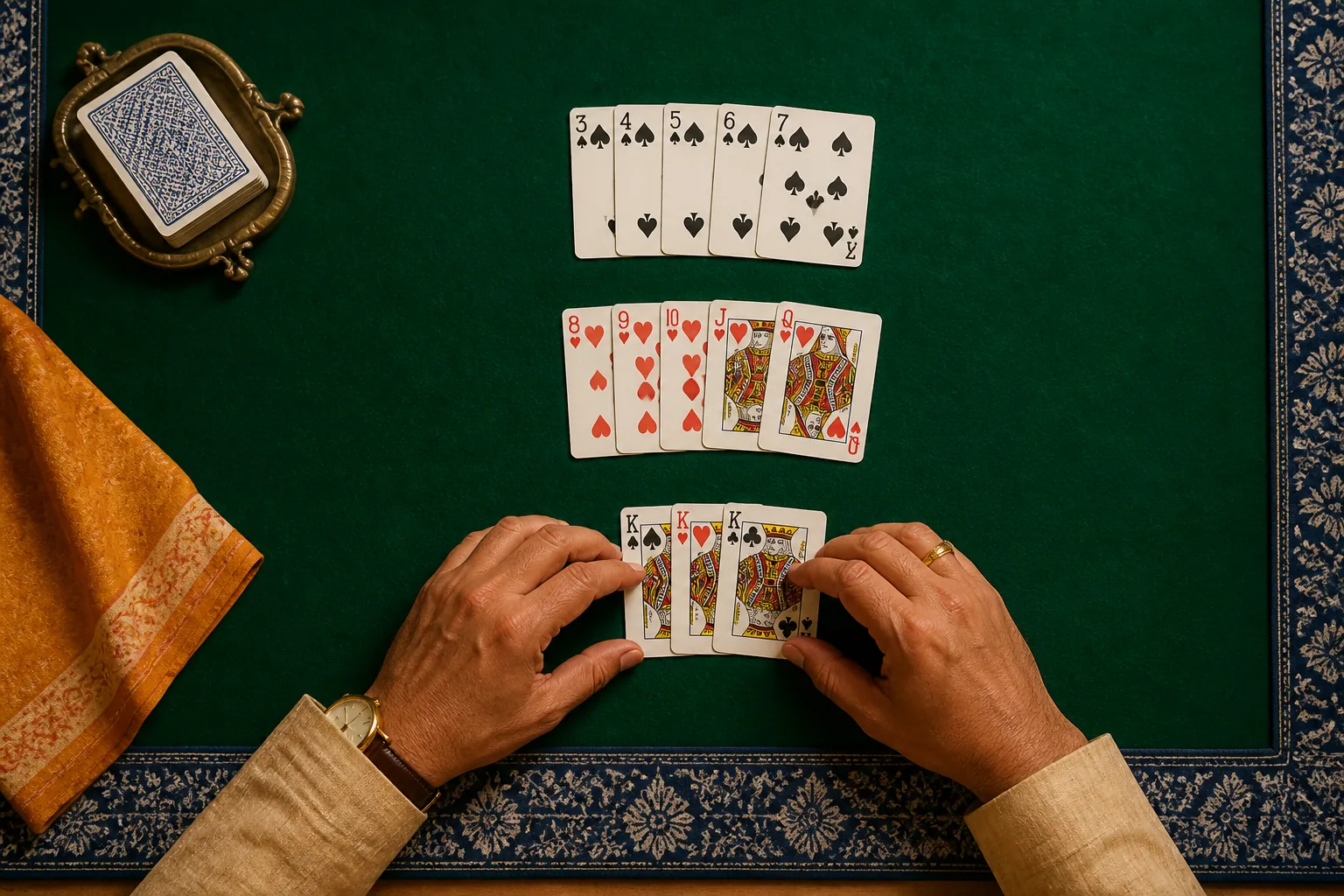
Quick answer: a joker can replace a missing card in many sets and sequences, but a substituted card makes a sequence impure. A valid 13-card declaration still needs at least one pure sequence.
Printed joker and wild joker
| Type | How it is identified | Common use |
|---|---|---|
| Printed joker | The deck card printed with a joker design | Substitutes for a missing rank in a valid group |
| Wild joker | A rank selected for the deal | Every card of that selected rank can act as a joker |
If 7 is selected as the wild rank, 7♠, 7♥, 7♦ and 7♣ can generally serve as wild jokers. Exact deck setup and selection rules depend on the table.
Using a joker in sequences
| Cards | Result |
|---|---|
| 5♥ 6♥ 7♥ | Pure sequence |
| 5♥ Joker 7♥ | Impure sequence; joker represents 6♥ |
| 9♣ 10♣ Joker Q♣ | Impure sequence; joker represents J♣ |
| 4♦ Joker 8♦ | Invalid under ordinary rules because one joker cannot fill several missing ranks |
A joker can help create the second required sequence, but a joker acting as a substitute cannot create the mandatory pure sequence.
Using a joker in sets
A joker can replace a missing same-rank card in a set. For example, K♠–K♥–Joker can form a joker-assisted set. The natural cards must still follow the set rule: same rank and normally different suits.
A group such as 8♠–9♥–Joker is not made valid merely by adding a joker. The non-joker cards must already be compatible with the type of group being formed.
When the wild-rank card appears naturally
Some games allow a card chosen as the wild rank to be used as its natural card when it occupies its own rank and suit position, while other product rules describe it differently. This edge case affects whether a run can be treated as pure, so use the rule displayed for the specific table.
Common joker mistakes
- Assuming a joker-assisted run is pure.
- Using one joker to cover more than one missing rank.
- Combining unrelated natural cards and expecting a joker to repair the group.
- Building several joker groups without first securing a pure sequence.
- Forgetting which rank was selected as wild for the current deal.
Practical handling
Jokers are flexible, but flexibility is most useful after the mandatory natural run is protected. Group the pure sequence first, then compare whether a joker creates a stronger second sequence or completes a difficult set. No joker decision guarantees a win.
Frequently asked questions
Can a joker be discarded?
Product rules can control joker pickup and discard behaviour. Check the instructions shown for the table.
Does a joker have point value?
A correctly used joker normally carries zero points in common Indian Rummy scoring.
Can I make a valid hand without a joker?
Yes. Jokers are helpful but not mandatory if every card forms valid natural sequences and sets.