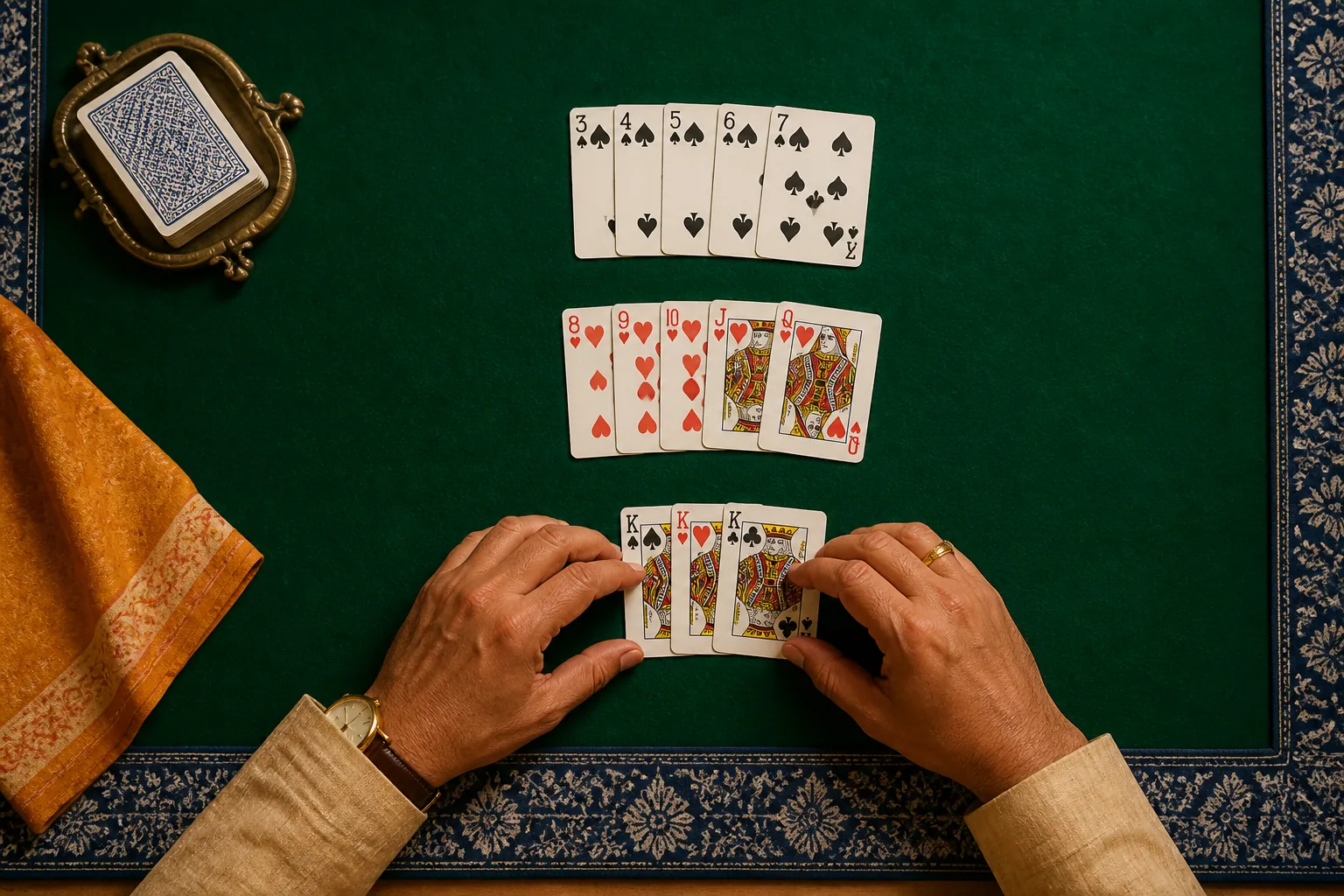
Quick answer: a standard valid declaration arranges all 13 cards into sequences and sets, includes at least two sequences and contains at least one pure sequence. No card can be left outside a valid group.
Four requirements for a valid declaration
- Use all 13 cards in recognised groups.
- Create at least two sequences.
- Make at least one of those sequences pure.
- Use only valid sets and sequences for every remaining card.
A hand can contain more than two sequences and does not always need a set. The mandatory structure is driven by the sequence requirements and the need to group every card correctly.
Complete 13-card valid hand
| Group | Cards | Type | Count |
|---|---|---|---|
| 1 | 4♠ 5♠ 6♠ | Pure sequence | 3 |
| 2 | 8♥ 9♥ 10♥ J♥ | Pure sequence | 4 |
| 3 | Q♣ Q♦ Q♥ | Set | 3 |
| 4 | 2♣ 3♣ Joker | Impure sequence | 3 |
The groups contain 3 + 4 + 3 + 3 = 13 cards. There are three sequences, two of them pure, and the remaining group is a valid set.
Common invalid declarations
| Problem | Why the hand fails |
|---|---|
| No pure sequence | Joker-assisted runs cannot replace the mandatory natural run. |
| Only one sequence | A standard declaration needs at least two sequences. |
| Duplicate suit in a set | A same-rank set normally uses different suits. |
| Mixed suits in a run | Consecutive ranks from different suits do not form a sequence. |
| One unmatched card | Every card must belong to a valid group. |
| K–A–2 sequence | Ace cannot normally wrap around the rank order. |
Declaration checklist
- Count the cards and confirm there are exactly 13 before the final action.
- Identify and lock the pure sequence.
- Confirm there is at least one additional sequence.
- Check each set for same rank and different suits.
- Confirm what every joker represents.
- Look for gaps, duplicate cards and ungrouped cards.
- Read any table-specific invalid-declaration penalty before submitting.
Pure versus impure sequence
A pure sequence uses natural consecutive cards in one suit. An impure sequence uses a joker as a substitute. Both can contribute to the hand, but at least one sequence must remain pure.
Review pure-sequence examples →
Frequently asked questions
Can I declare with three sequences and one set?
Yes, if at least one sequence is pure and all 13 cards form valid groups.
Do I need a set?
Not necessarily. A hand made entirely from valid sequences can qualify if it meets the pure and second-sequence requirements.
Can I use two jokers in one group?
Platform rules can limit joker use or group structure. Verify the table rule and ensure the group still meets its definition.
What happens after an invalid declaration?
Penalties vary by product and format. Check the rules shown for the specific table before playing.