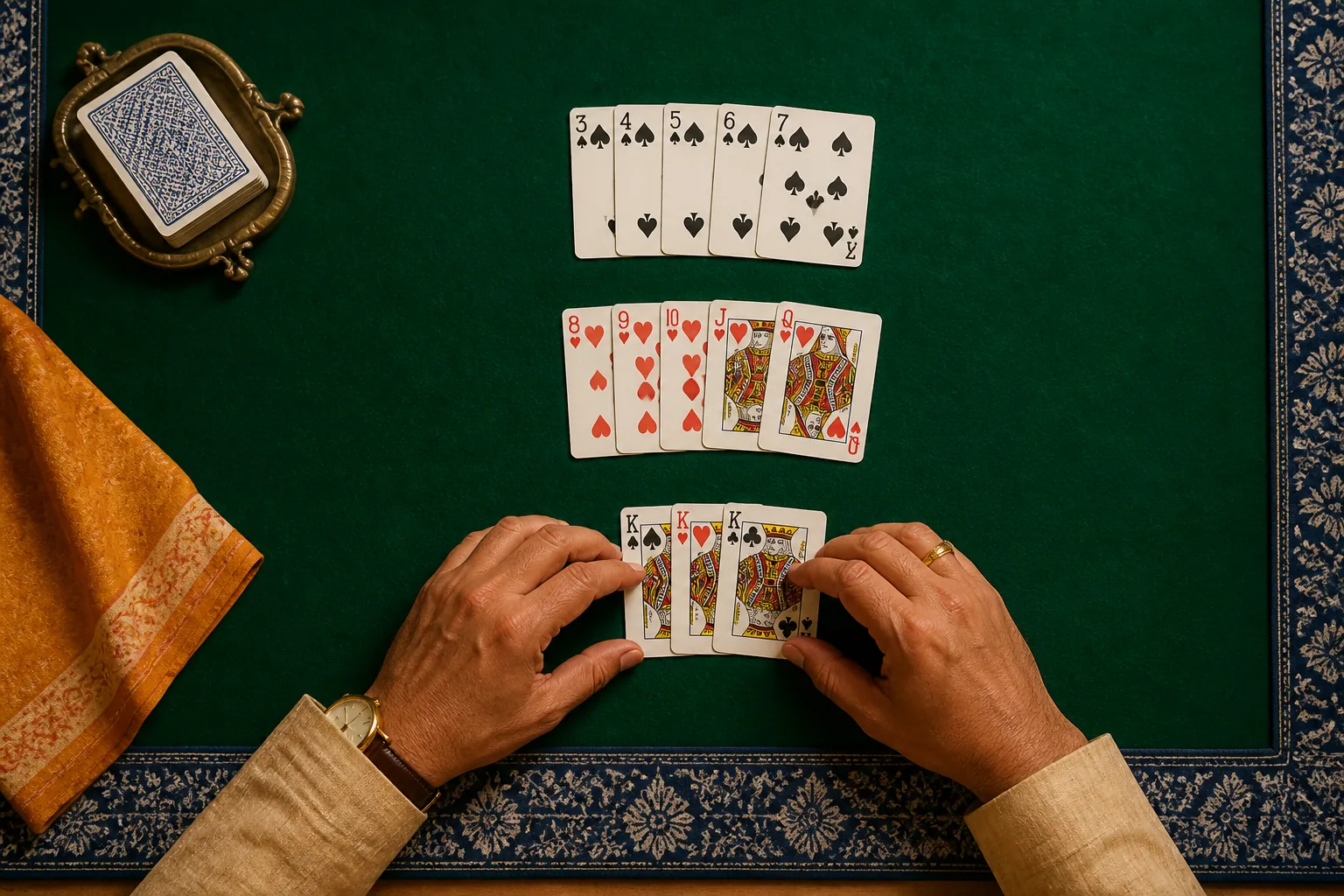
Quick answer: Each player receives 13 cards. Draw one card and discard one on every turn. To make a valid declaration, arrange all cards into sequences and sets with at least two sequences, including at least one pure sequence.
Focused Rummy rule guides
Pure sequence
Compare valid and invalid runs, including ace and joker edge cases.
Pure sequence guide →Valid declaration
Check a complete 13-card hand and the mistakes that invalidate it.
Declaration guide →Objective and setup
The aim is to organise all 13 cards into valid combinations before the other players. The exact number of decks and printed jokers depends on the table size and the rules shown for each Master Rummy table.
| Item | Standard guide value |
|---|---|
| Players | 2–6 |
| Cards per player | 13 |
| Turn | Draw one, discard one |
| Valid hand | At least two sequences, including one pure |
| Maximum losing points | Usually 80 |
What happens on a turn?
- Choose the top card from the closed deck or the visible discard pile.
- Rearrange the 14 cards in your hand into possible groups.
- Discard one unwanted card so you return to 13 cards.
- If all 13 cards form valid groups, make a declaration according to the table interface.
Pure and impure sequences
Pure sequence
Three or more consecutive cards from the same suit without a wild or printed joker substituting for a missing card. Example: 5♥–6♥–7♥.
Impure sequence
Three or more consecutive cards from the same suit where a joker substitutes for a missing card. Example: 8♣–9♣–Joker–J♣, where the joker represents 10♣.
What counts as a set?
A set contains three or four cards of the same rank in different suits, such as 9♠–9♥–9♣. Duplicate suits in one set are normally not valid. Jokers may substitute according to the table rules.
Valid declaration example
| Group | Cards | Type |
|---|---|---|
| 1 | 4♠ 5♠ 6♠ | Pure sequence |
| 2 | 8♥ 9♥ 10♥ J♥ | Pure sequence |
| 3 | Q♣ Q♦ Q♥ | Set |
| 4 | 2♣ 3♣ Joker | Impure sequence |
Indian Rummy scoring
Number cards usually carry their face value. Aces, kings, queens, jacks and tens count as 10 points each. Jokers count as zero when used correctly. The losing hand is commonly capped at 80 points, while a valid declaring hand scores zero.
Try the Rummy score calculator →
Common beginner mistakes
- Building sets before securing a pure sequence.
- Keeping several unmatched high-value cards for too long.
- Assuming every three consecutive ranks form a sequence even when suits differ.
- Making a declaration with only one sequence.
- Applying rules from Gin Rummy or a local house game to Indian Rummy.
Frequently asked questions
How many cards does each player receive?
Each player receives 13 cards in the standard Indian Rummy format covered by this guide.
Can ace be high and low?
Ace is commonly used before 2 or after king, but not as a bridge such as K–A–2. Confirm the exact table rule before playing.
Do I always need a pure sequence?
Yes, the standard valid-hand requirement covered here includes at least one pure sequence.